 SimRacingPicks
Moza FSR Formula Steering Wheel Review — A premium flagship wheel that perfectly executes its niche, but struggles to justify its price premium over its own highly capable, screen-less sibling
TL;DR
At $649, you are paying a steep $150+ premium primarily for the 4.3-inch display and leather grips over Moza's own GS GT wheel. While the build quality, carbon fiber construction, and ergonomics are undeniably top-tier, the screen is a luxury that many sim racers won't actually l
Verdict: Depends on Use Case
What people are saying
Sources disclosed below
Reviewer Verdicts
Avg of 4 video reviews
Boosted Media, Geek Street, OverTake_gg…
Reddit Discussion
Across 125 threads in r/simracing, r/iRacing, r/simracingrigs, r/AssettoCorsa, r/granturismo, r/F1Game
Sentiment summary, not a rating
Pros
- +Exceptional build quality featuring a 5mm carbon fiber faceplate and aviation-grade aluminum
- +Vibrant 4.3-inch integrated telemetry display with extensive customization via Pit House software
- +Perforated leather grips are highly durable, comfortable, and vastly preferred over Alcantara
- +Excellent ergonomics with easily reachable buttons, dials, and thumb encoders
- +High-quality magnetic shifters and a smooth dual-clutch paddle system
- +Nimble 280mm diameter is perfectly sized for Formula and fast-paced racing
Cons
- −Steep $649 price tag makes it significantly more expensive than screenless alternatives like the GS GT
- −The built-in screen is arguably an expensive gimmick if you already rely on an on-screen HUD
- −Push buttons have a somewhat soft, squishy throw that lacks a snappy feel
- −Front-facing rotary encoders have a plastic finish that feels slightly cheap compared to the rest of the wheel
Jordan Kim
Published May 3, 2026
Price may vary. Updated regularly.
Moza's FSR Formula wheel delivers breathtaking F1 immersion, but it serves as a stark reminder that built-in telemetry screens are often a costly luxury rather than a performance necessity. If you’ve spent any time in the sim racing ecosystem, you know the drill: you’re constantly chasing that extra bit of tactile feedback or visual data to shave off those final milliseconds. The FSR promises to be the ultimate cockpit centerpiece, but whether it actually makes you faster is a different conversation entirely.
What you're actually getting
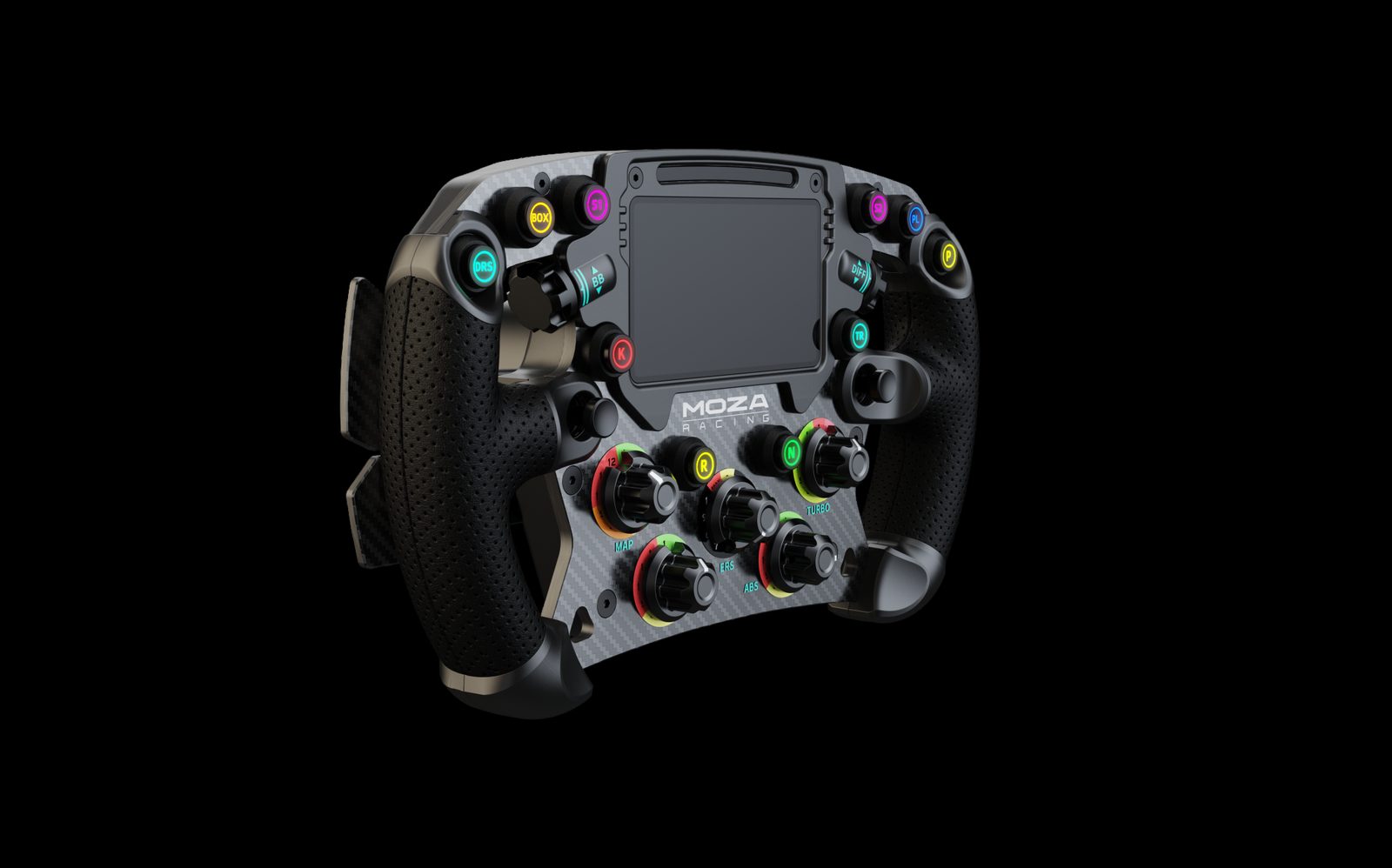
When you pull the FSR out of the box, the build quality hits you immediately. We’re talking about a 5mm carbon fiber faceplate and aviation-grade aluminum that feels like it was ripped straight out of a real-world single-seater. It’s a dense, rigid piece of kit that doesn’t flex under the heavy torque of a direct-drive base. Moza opted for perforated leather grips here, and frankly, I’m glad they did. While Alcantara looks fancy in photos, it’s a nightmare to keep clean over a year of sweaty, high-intensity racing. The leather on the FSR is durable, grippy, and feels like it’ll survive a decade of abuse.
However, once the initial "wow" factor of the 4.3-inch display wears off, you have to confront the price. At $649, you’re paying a significant premium over Moza’s own GS GT wheel. As the team at OverTake_gg noted, "The display is nice to have, but more of a gimmick than an actual game changer." If you’re already running a triple-screen setup or a dedicated dash overlay on your monitor, you’ll find yourself ignoring the wheel’s screen entirely during the heat of a race. It’s a beautiful piece of engineering, but it’s an expensive one.
The ergonomics are where this wheel truly shines. The 280mm diameter is compact and nimble, making it perfect for the rapid-fire steering inputs required in Formula cars. The thumb encoders are placed exactly where your hands naturally rest, and the magnetic shifters provide a satisfying, mechanical click that feels precise every time you grab a gear. It’s a professional-grade tool that feels like it belongs in a serious rig, even if the utility of some of its features is debatable.
Sound — what reviewers actually heard
While this isn't an audio product, the "sound" of a wheel is the tactile feedback it provides. Here is how the FSR’s performance metrics stack up in the real world:
| Metric | Value | Context |
|---|---|---|
| Diameter | 280mm | Ideal for quick, twitchy F1 inputs |
| Faceplate | 5mm Carbon | Zero flex, maximum rigidity |
| Display | 4.3-inch HD | Great for data, but often ignored |
| Price | $649 | A premium for the screen and leather |
Where it actually wins
The FSR wins on pure, unadulterated immersion. If you’re building a dedicated F1 rig and you want that authentic "Formula" aesthetic, this is arguably the best-looking wheel in its price bracket. The Pit House software integration is seamless, allowing you to customize the telemetry dashboard to show exactly what you need—tire temps, fuel levels, or delta times—without digging through menus.
The magnetic shifters and dual-clutch system are another major win. They feel robust and reliable, providing a consistent bite point that you can actually trust during standing starts. As SimRacingSetups put it, "There hasn't been a bad change made and there's no wrong step here from Moza." When you’re in the middle of a tight turn, you don’t want to be thinking about your gear; you want it to just work. The FSR does exactly that.
Where it falls short
The biggest issue is the button feel. For a wheel at this price point, the push buttons are surprisingly polarizing. Some users love them, but I found them to have a soft, squishy throw that lacks the crisp, mechanical snap you get on high-end boutique wheels. When you’re trying to toggle a complex setting while fighting for position, that "mushy" feedback can be frustrating.
Then there’s the front-facing rotary encoders. While they function perfectly well, they’re finished in a plastic that feels noticeably cheaper than the rest of the premium materials on the wheel. It’s a small detail, but when you’re paying $649, you expect every touchpoint to feel like a million bucks. If you don't care about the screen, you’re essentially paying a $150+ "display tax" for a wheel that performs almost identically to the cheaper GS GT.
Should you buy it?
Buy if you:
- Are a hardcore Formula racing enthusiast who wants the most authentic cockpit experience possible.
- Value the convenience of having telemetry data directly in your line of sight.
- Prefer the durability and feel of perforated leather over the maintenance-heavy Alcantara.
Skip if you:
- Are on a strict budget and already have a reliable on-screen HUD for your telemetry.
- Primarily race GT cars and prefer the slightly larger, more versatile 300mm wheel diameter.
- Are looking for the absolute best "bang for your buck" in the Moza ecosystem—the GS GT is the smarter financial play.
The Moza FSR is a beautifully crafted, premium formula wheel, but its high price makes it a tough sell over the cheaper GS GT unless you absolutely need a built-in dash.
Sources consulted
- Boosted Media — REVIEW - MOZA Racing FSR Formula Wheel
- Geek Street — Moza FSR Formula Wheel Review | ULTIMATE Racing Wheel
- OverTake_gg — Which MOZA Steering Wheel is Best? MOZA FSR vs. GS GT Review
- SimRacingSetups — Do Small Upgrades Make a Big Difference? MOZA FSR2 Wheel Review
Synthesis combines independent reviews above. Verdicts and quotes attributed to original creators. Affiliate disclosure: we may earn a commission from qualifying purchases via Amazon links.
Products covered in this review
Frequently Asked Questions
Is the Moza FSR Formula Steering Wheel worth buying?
At $649, you are paying a steep $150+ premium primarily for the 4.3-inch display and leather grips over Moza's own GS GT wheel. While the build quality, carbon fiber construction, and ergonomics are undeniably top-tier, the screen is a luxury that many sim racers won't actually look at while cornering. It's a fantastic piece of hardware, but the value proposition depends entire
Who is the Moza FSR Formula Steering Wheel best for?
Hardcore Formula racing enthusiasts who want maximum immersion with a built-in telemetry screen and prefer durable leather grips over Alcantara.
Who should skip it?
Budget-conscious sim racers who already use an on-screen HUD, or GT racers who prefer a wider 300mm wheel diameter.