 SimRacingPicks
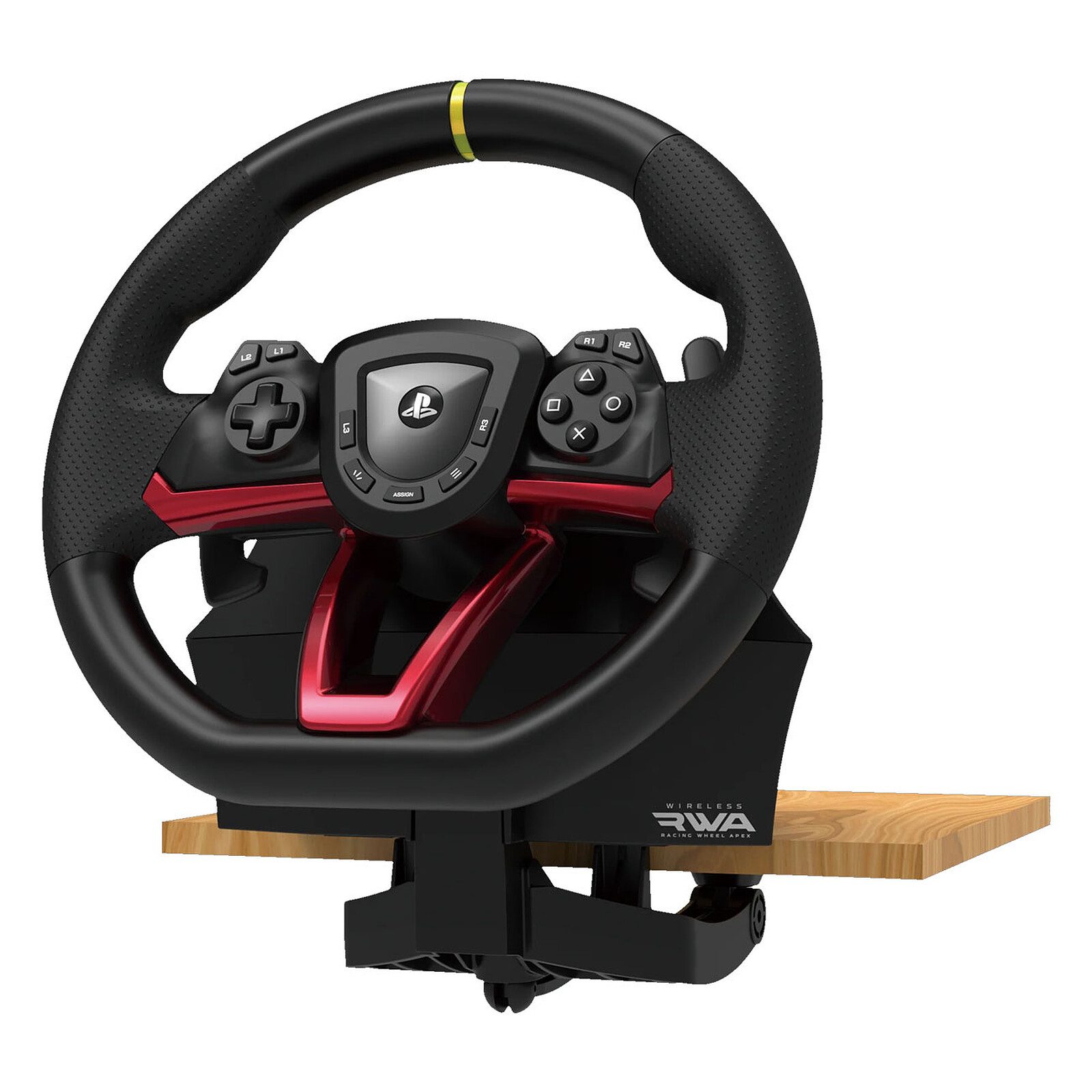
HORI Wireless Racing Wheel Apex (PS5/PS4/PC) Review — An ultra-budget underdog that requires frustrating out-of-the-box tweaking, but ultimately delivers a fun casual arcade experience if you accept its physical limitations
TL;DR
At $99, you get a solid rubberized rim and plenty of buttons, making it a fun step up from a gamepad for casual track racing. However, the bungee-cord centering and complete lack of force feedback mean you can't physically feel the car's grip, making it highly impractical for ser
Verdict: Depends on Use Case
What people are saying
Sources disclosed below
Reviewer Verdicts
Avg of 4 video reviews
Inside Sim Racing, Zerum, Bryan's Tech Corner…
Reddit Discussion
Across 2 threads in r/simracing, r/iRacing, r/simracingrigs, r/AssettoCorsa, r/granturismo, r/F1Game
Sentiment summary, not a rating
Pros
- +Extremely budget-friendly at around $99
- +Comfortable rubberized grips and solid overall build quality for the price
- +Extensive on-wheel adjustability and programmable buttons
- +Fold-out plastic flap on the pedals significantly improves stability
- +A definitive upgrade over a standard controller for casual track racing
Cons
- −Complete lack of force feedback (relies on a bungee/spring centering system)
- −Pedals are lightweight and slide easily on hard floors without a rug or wall
- −Desk clamp is flimsy and can wiggle loose during heavy use
- −Limited to 270 degrees of rotation, which restricts precision
- −The default 'Normal' mode is virtually unplayable due to massive deadzones
Jordan Kim
Published May 3, 2026
Price may vary. Updated regularly.
HORI's $99 wheel hides a massive deadzone out of the box—until you flip one hidden switch. If you’re expecting a plug-and-play experience that makes you feel like a GT3 driver, you’re going to be disappointed within the first five minutes. But if you’re willing to dig into the settings, there’s a surprisingly decent arcade controller buried under that plastic shell.
What you're actually getting
When you unbox the HORI Wireless Racing Wheel Apex, you aren't buying a simulator peripheral; you’re buying a glorified, ergonomic gamepad shaped like a steering wheel. The build quality is surprisingly punchy for the price point, featuring rubberized grips that feel far more premium than the hollow plastic housing suggests. It’s a sturdy piece of kit for the desk, provided you don't treat it like a professional direct-drive base.
The real issue is the "out of the box" experience. As Inside Sim Racing bluntly noted, "I could measure the dead zone with a yard stick." If you plug this in and start racing, you’ll find yourself turning the wheel significantly before the car even twitches. You absolutely must dive into the on-wheel programming to adjust the sensitivity and deadzones. Once you do, the experience shifts from "unplayable" to "fun."
However, you need to manage your expectations regarding the mechanics. This wheel uses a bungee-cord centering system rather than a motor-driven force feedback system. You aren't going to feel the tires losing grip or the rumble strips on a curb. As Wicked Gamer & Collector pointed out, "This is one of the most difficult games to play with a racing wheel because we don't have any feedback." You are essentially steering by sight alone, which makes high-stakes sim racing a chore.
Sound and performance reality
| Metric | Value | Context |
|---|---|---|
| Price | $99 | Budget-tier entry |
| Rotation Angle | 270 degrees | Limited; arcade-focused |
| Wheel Diameter | 28 cm | Compact, standard size |
| Battery Life | 10 hours | Sufficient for long sessions |
- The "Bungee" Reality: Because there is no force feedback motor, the wheel always wants to return to center with a springy, artificial tension. It’s consistent, but it lacks the nuance of a real steering rack.
- The Pedal Problem: The pedals are lightweight. If you’re playing on a hardwood floor, they will slide away from you during a heavy braking zone. Use the fold-out plastic flap to brace them against a wall, or you’ll be chasing them across the room.
- The Clamp: The desk clamp is functional but prone to wiggling if you’re an aggressive driver. Don’t expect it to stay rock-solid during a high-intensity drift session.
Where it actually wins
The HORI Apex shines when you stop trying to treat it like a professional simulator and start using it for what it is: a fun, casual arcade upgrade. If you’re playing Gran Turismo or Need for Speed on your couch, it’s a massive step up from a standard controller. The button layout is intuitive, and the ability to program inputs directly on the wheel is a pro-level feature that you rarely see at this price point.
The build quality is another win. It doesn't feel like it’s going to snap in your hands, which is a common fear with sub-$100 hardware. The rubberized grips are comfortable for hour-long sessions, and the wireless connectivity is stable enough that you won't be dealing with input lag during casual races. It’s the perfect "closet wheel"—easy to set up, easy to store, and great for when you just want to goof around for an hour.
Where it falls short
The lack of force feedback is the elephant in the room. In the world of sim racing, force feedback is the primary way you communicate with the car. Without it, you’re flying blind. You’ll find yourself over-correcting constantly because you can’t feel the weight of the steering. As Inside Sim Racing put it, "The development effort clearly went into the wheel and the pedals were designed over someone's lunch break."
The 270-degree rotation is also a major bottleneck. Modern racing games are designed for wheels with 900-degree rotation or more. With only 270 degrees, your steering inputs are twitchy and hyper-sensitive. You’ll find it nearly impossible to make smooth, precise adjustments in tight corners. If you’re looking to get into competitive sim racing, this wheel will become a frustration point within a month.
Should you buy it?
Buy if you:
- Are a casual gamer who wants a more immersive experience for arcade-style racers.
- Are on a strict $99 budget and refuse to use a standard controller.
- Need a compact, wireless solution that’s easy to pull out and put away.
Skip if you:
- Want to play serious simulators like iRacing or Assetto Corsa.
- Need force feedback to feel the car's traction and weight.
- Are looking for a long-term investment for a dedicated sim rig.
A capable entry-level wheel for casual arcade racers, but the lack of force feedback makes it a dead end for sim enthusiasts.
Sources consulted
- Inside Sim Racing — HORI Racing Wheel Apex Review - Is a $99 Wheel a Good Idea?
- Zerum — Best Racing Sim Wheel Under $100?! | HORI Racing Wheel Apex | Is it Worth Buying?
- Bryan's Tech Corner — Hori Racing Wheel APEX – Things To Know Before You Buy
- Wicked Gamer & Collector and Wicked Racing — Budget Friendly PS5 Gaming Solution! ... Hori RWA Apex Racing Wheel!
Synthesis combines independent reviews above. Verdicts and quotes attributed to original creators. Affiliate disclosure: we may earn a commission from qualifying purchases via Amazon links.
Products covered in this review
Frequently Asked Questions
Is the HORI Wireless Racing Wheel Apex (PS5/PS4/PC) worth buying?
At $99, you get a solid rubberized rim and plenty of buttons, making it a fun step up from a gamepad for casual track racing. However, the bungee-cord centering and complete lack of force feedback mean you can't physically feel the car's grip, making it highly impractical for serious simulators or unpredictable off-road games.
Who is the HORI Wireless Racing Wheel Apex (PS5/PS4/PC) best for?
Casual gamers on a strict budget playing track racers like Gran Turismo who want a steering wheel experience without the premium cost.
Who should skip it?
Serious sim racers, drifting enthusiasts, or anyone playing chaotic off-road games where force feedback is required to feel traction loss.