 SimRacingPicks
HORI Racing Wheel Apex (PS5/PS4/PC) — Officially Licensed by Sony Review — An ultra-budget wheel overcomes terrible default settings and flimsy pedals to deliver genuine arcade fun for casuals
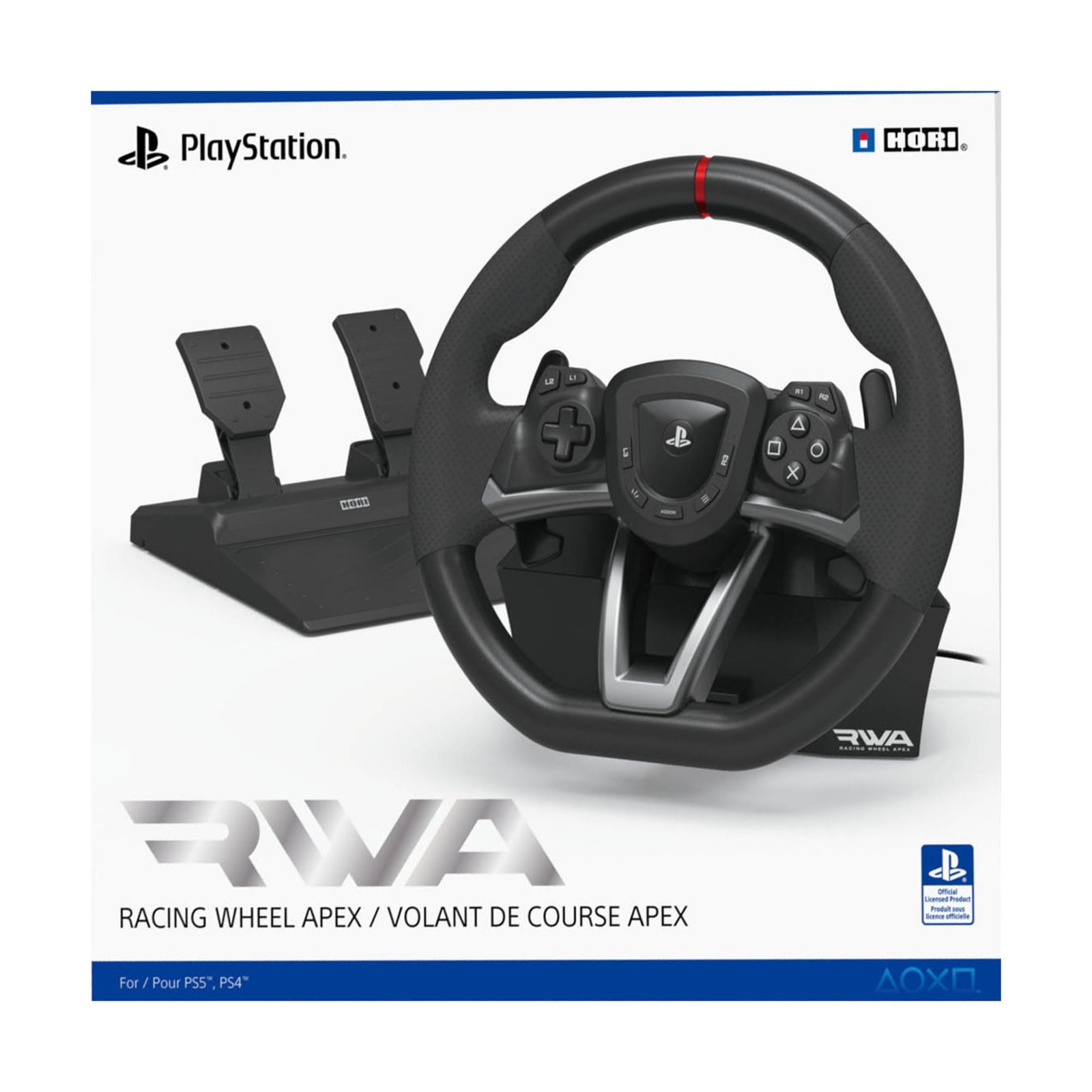
Reviewed Product
HORI Racing Wheel Apex (PS5/PS4/PC) — Officially Licensed by Sony$113.99 – $143.99 USD
TL;DR
At $99, you get what you pay for: a bungee-cord centering system with zero force feedback and pedals that love to slide across the floor. However, if you take the time to switch it out of its terrible default mode and adjust the deadzones, it provides a fun, arcade-like step up f
Verdict: Depends on Use Case
What people are saying
Sources disclosed below
Reviewer Verdicts
Avg of 4 video reviews
Inside Sim Racing, Zerum, Death Lazer Boy…
Pros
- +Comfortable rubber grip and solid build quality on the wheel rim
- +Abundance of well-placed, standard PlayStation buttons
- +Fold-out plastic flap on the pedals helps improve stability
- +Highly adjustable deadzones and sensitivity settings directly on the wheel
Cons
- −Zero force feedback due to a basic bungee/spring centering system
- −Pedals slide easily on hard floors without a wall or rug
- −Terrible out-of-the-box performance until switched to 'PS4-S' mode
- −Paddle shifters feel cheap and flimsy
- −Small 28cm (10-11 inch) wheel diameter feels toy-like
- −Limited 270-degree rotation hinders sharp cornering
Jordan Kim
Published May 3, 2026
Price may vary. Updated regularly.
This $99 racing wheel is genuinely terrible out of the box—until you flip one hidden switch. If you plug it in and immediately start racing, you’ll likely spend the next ten minutes wondering why you didn't just stick with your DualSense controller.
What you're actually getting
The HORI Racing Wheel Apex (RWA) is not a sim-racing peripheral; it’s a plastic, wheel-shaped gamepad that happens to mount to your desk. When you first unbox it, the steering feels like you’re fighting a thick rubber band, and the deadzones are so wide you could drive a truck through them. As Inside Sim Racing bluntly noted, "I could measure the dead zone with a yard stick." It’s a frustrating experience that makes the wheel feel broken.
However, the RWA has a secret: if you switch the input mode to "PS4-S," the behavior shifts from "unusable" to "passable." Once you dial in the sensitivity and deadzone settings directly on the wheel—which, to be fair, is a surprisingly robust feature for this price point—it becomes a functional tool for arcade racers. It’s not going to give you the granular feedback of a direct-drive base, but it offers a tactile, immersive experience that a thumbstick simply cannot replicate.
Build quality is exactly what you’d expect for a hundred bucks. The rubberized grip on the rim feels decent in the hands, and the button layout is excellent, mirroring the PlayStation controller perfectly. But don't be fooled by the "officially licensed" badge. The paddle shifters feel like they were harvested from a cheap toy, and the 270-degree rotation limit means you’ll be doing a lot of frantic, jerky steering during tight hairpins. It’s a compromise-heavy piece of kit that prioritizes accessibility over performance.
Sound — what reviewers actually heard
While this isn't an audio product, the "sound" of the RWA is the hollow, plastic clatter of its pedals hitting the floor and the faint whine of the internal centering springs. Here is how the hardware stacks up:
| Metric | Value | Context |
|---|---|---|
| Price | $99 | Entry-level budget |
| Rotation | 270 degrees | Arcade-style, not sim |
| Diameter | 28 cm | Feels small/toy-like |
| Feedback | None | Bungee-cord centering |
Where it actually wins
The RWA wins on pure, unadulterated accessibility. If you’re a parent buying a gift for a child, or a casual gamer who wants to play Need for Speed or The Crew without spending half a mortgage payment on a Fanatec setup, this wheel hits the mark. The desk clamp, while debated by some, is perfectly adequate for a light-duty setup, and the fold-out plastic flap on the pedal unit is a clever—if simple—way to keep the pedals from sliding away on carpet.
The onboard customization is the real hero here. Being able to adjust sensitivity and deadzones directly on the wheel without needing to dive into complex PC software is a massive win for the target demographic. It’s a "plug-and-play" experience once you’ve learned the quirks. As Zerum put it, "I found myself sitting there with a big stupid grin on my face just having fun." That’s the RWA’s true purpose: it’s not about shaving milliseconds off a lap time; it’s about the grin.
Where it falls short
The lack of force feedback is the elephant in the room. Without a motor to simulate road texture, tire slip, or weight transfer, you are essentially driving blind. You have to rely entirely on visual cues on the screen to know when you’re losing grip, which makes it nearly impossible to develop the muscle memory required for serious sim racing.
Then there are the pedals. They are light, flimsy, and prone to sliding across hardwood floors unless you have them braced against a wall. Inside Sim Racing didn't mince words, stating, "The pedals were designed over someone's lunch break." If you’re a competitive player, the 270-degree rotation will be your biggest enemy. It’s just not enough travel for precise control, and you’ll find yourself over-correcting constantly. It’s a toy, not a simulator, and it’s important to manage your expectations accordingly.
Should you buy it?
Buy if you
- Are a casual gamer looking for an arcade-style experience.
- Want a budget-friendly gift for a younger player.
- Only play arcade racers where precision and force feedback aren't required.
- Need a wheel that is easy to set up and store away.
Skip if you
- Are trying to get into competitive sim racing (iRacing, ACC, etc.).
- Expect the "feel" of a real car or a high-end force-feedback wheel.
- Have a dedicated racing rig and want to improve your lap times.
- Are easily annoyed by cheap, plasticky build quality.
A glorified, wheel-shaped controller that offers cheap thrills for casuals but lacks the force feedback required for true sim racing.
Sources consulted
- Inside Sim Racing — HORI Racing Wheel Apex Review - Is a $99 Wheel a Good Idea?
- Zerum — Best Racing Sim Wheel Under $100?! | HORI Racing Wheel Apex | Is it Worth Buying?
- Death Lazer Boy — HORI Racing Wheel Apex For PS5, PS4 PC RWA Unboxing & Use GT
- Bryan's Tech Corner — Hori Racing Wheel APEX – Things To Know Before You Buy
Synthesis combines independent reviews above. Verdicts and quotes attributed to original creators. Affiliate disclosure: we may earn a commission from qualifying purchases via Amazon links.
Products covered in this review
Frequently Asked Questions
Is the HORI Racing Wheel Apex (PS5/PS4/PC) — Officially Licensed by Sony worth buying?
At $99, you get what you pay for: a bungee-cord centering system with zero force feedback and pedals that love to slide across the floor. However, if you take the time to switch it out of its terrible default mode and adjust the deadzones, it provides a fun, arcade-like step up from a standard gamepad.
Who is the HORI Racing Wheel Apex (PS5/PS4/PC) — Officially Licensed by Sony best for?
Kids, casual arcade racers, and absolute beginners who want a steering wheel prop for under $100.
Who should skip it?
Anyone looking for realistic sim racing, force feedback, or competitive lap times.